Answer Engine Optimisation, Minus the Panic
Most AEO advice has already expired. Here's the part that hasn't, and won't.
DIRECT ANSWER
Answer Engine Optimisation (AEO) means making sure ChatGPT, Perplexity, Google's AI Overviews and similar tools can find, trust and cite your content. The tactics sold under that name change every few months, and most don't survive contact with the evidence. What survives: solving a real problem better than anyone else has bothered to, writing it up clearly, and being the kind of brand other people, and increasingly other models, choose to mention unprompted. AEO isn't a new discipline. It's SEO and brand strategy, tested faster.
What's actually changed
Start with what's true regardless of which acronym wins.
Search stopped being a list of ten blue links some time ago, but 2026 is when the shift became impossible to ignore. SparkToro's most recent analysis of US Google search behaviour put the zero-click rate at 68 per cent: fewer than a third of searches now end with someone clicking through to a website at all. On queries where an AI Overview appears, that number climbs higher still.
This isn't a consumer-only trend. Forrester's 2026 buyers' journey research, drawn from close to 18,000 business buyers worldwide, found that 94 per cent had used generative AI somewhere in their most recent purchase process, and that buyers now rate conversational AI search as a more useful source of information than a vendor's own website, a product expert, or a salesperson.
People haven't stopped researching; more of that research now happens inside a single synthesised answer rather than across ten separate tabs. If your content, your brand, and your point of view aren't part of what gets synthesised, you're increasingly invisible at the exact moment someone's deciding what to do next.
Worth being precise about this, since Google's documentation carries real weight in this piece. The behavioural data above, the zero-click numbers, comes from SparkToro's independent measurement, not from Google itself. Where Google's own technical statements get cited, on llms.txt, on schema, on what its AI features require, it's because independent researchers checked and found the same thing, not because Google said so. Google also has an obvious incentive to tell the market to stay calm and keep doing normal SEO: panic is bad for its ad business. Treat its guidance the way you'd treat any vendor's claims about its own system, useful, checkable, and not the last word.
The gold rush
Naturally, an entire industry showed up to solve this.
Within about eighteen months, "AEO" and "GEO" went from a niche academic term to a five-figure line item on marketing budgets, sold by consultants who, in some cases, didn't exist as consultants twelve months earlier. Every week brings a new acronym, a new "must-have" tactic, a new dashboard promising to measure your "share of model" against competitors.
Some of this is genuinely useful. Most of it is the SEO industry's oldest trick wearing a new coat: manufacture urgency around a shortcut, sell the shortcut, move on before anyone checks whether it worked. Google's own John Mueller made roughly this point on Reddit, comparing one popular AEO tactic to the long-dead keywords meta tag: a signal nobody important uses, kept alive mostly by people selling advice about it.
Worth remembering before you spend a retainer on anything with "AI visibility" in the name: the tactics are new. The pattern isn't.
The graveyard
Here's the receipts. Four tactics that were sold hard, and what happened to them.
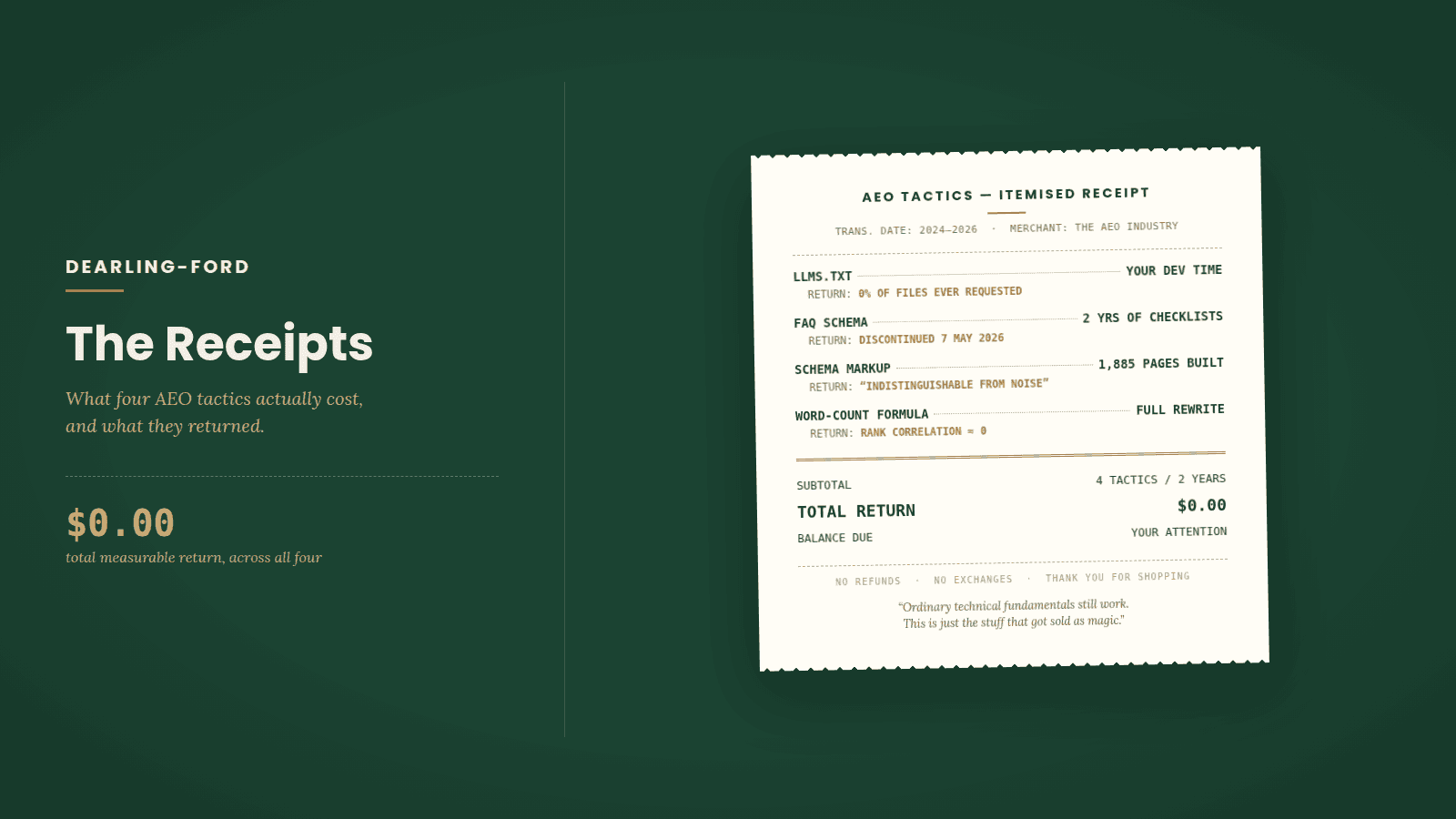
llms.txt. Promoted through 2024 and 2025 as the file every AI-ready website needed: a simple text summary, sitting on your server, that would supposedly help AI crawlers understand your site. Ahrefs checked. Across 137,000 domains, 97 per cent of the llms.txt files that existed had never been requested by anything. Google's Gary Illyes confirmed at a Search Central event that Google doesn't support the file and has no plans to. Mueller, asked directly whether Google's own use of the file counted as an endorsement, said no.
FAQ schema. For years, the single most repeated piece of AEO advice: mark up your FAQs so Google, and by extension everything trained on Google, can lift them straight into an answer. On 7 May 2026, Google switched FAQ rich results off completely. Search Console reporting followed within weeks. The tactic that half the "AEO checklists" in circulation were built around no longer has anywhere to appear.
Schema markup, generally. A softer case, worth including because it shows how correlation gets sold as causation. Pages with structured data are indeed more likely to get cited by AI tools, which is exactly why agencies pitch schema as a growth lever. Ahrefs ran the actual experiment: added schema to 1,885 pages, tracked them against matched pages that didn't get it. The result was no citation lift. ChatGPT and Google AI Mode were statistically indistinguishable from doing nothing; AI Overviews went slightly down.
Word-count formulas and "AI-optimised rewriting." A wave of services promised to restructure existing content into short, chunked, AI-friendly blocks, sometimes with an exact target word count per answer. Google's own generative AI guidance, published in May 2026, states there's no ideal page length and no need to break content into pieces for AI's benefit. Academic testing has gone further: a 2026 study out of MIT and Columbia found that pages rewritten to a GEO formula often ranked worse than the originals, and that length changes had no measurable relationship to rank.
Four tactics and four short lifespans. Ordinary technical fundamentals – crawlability, clean site structure, fast pages – still matter and always have. What's been proven to be untrue specifically is the exotic, AI-only layer built on top of them – the special file, the extra markup, the magic word count. It was dressed up as new and important, but it was really just noise.
Doesn't AI mean I can just publish more?
This is the question I get most, whatever words people use to ask it, and it's on nearly every content job spec now: how are you using AI to do more with less? Worth separating two things people mean by "more," because the honest answer differs for each.
Padding means stretching a single piece with extra words and filler paragraphs that don't add value. The evidence here is unusually clear. Content padding and keyword stuffing were both tested in the 2024 academic study that coined the term "Generative Engine Optimization", and both did almost nothing. A more rigorous 2025 study found most AI-search-gaming tactics either don't work or actively hurt a page's chances, and that substance-first content performs significantly better. Padding is a dead end, whether AI writes it or you do.
Coverage means something different: answering more real user questions faster because AI speeds up research and drafting. Answering twenty real customer questions well has always expanded reach – it’s standard topic cluster logic, just accelerated. More real answers create more surface area for AI engines to discover and cite.
The catch? "Well" is doing all the heavy lifting in that sentence.
AI-powered scaling creates two distinct risks that can undermine your citation gains:
The model problem: LLMs evaluate information density and consensus. When volume scales faster than original insight, pieces blur together into generic noise that engines skip over in favor of authoritative primary sources.
The trust problem: The moment quality or accuracy slips on one piece, you burn the credibility the other nineteen rely on. Studies show audience distrust doubles when content feels visibly templated or unvetted.
The rule for scaling
More is only an advantage if you can hold the editorial bar steady as volume climbs.
AI tools excel at synthesis, initial drafting, and surfacing edge-case questions. What they cannot manufacture is the original perspective – the practitioner data, real customer conversations, and tested points of view that make an answer cite-worthy. Scale those unique inputs, and increased volume compounds your reach. Scale generic drafts around them, and you produce invisible noise.
Why AI cites you (and why it doesn’t)
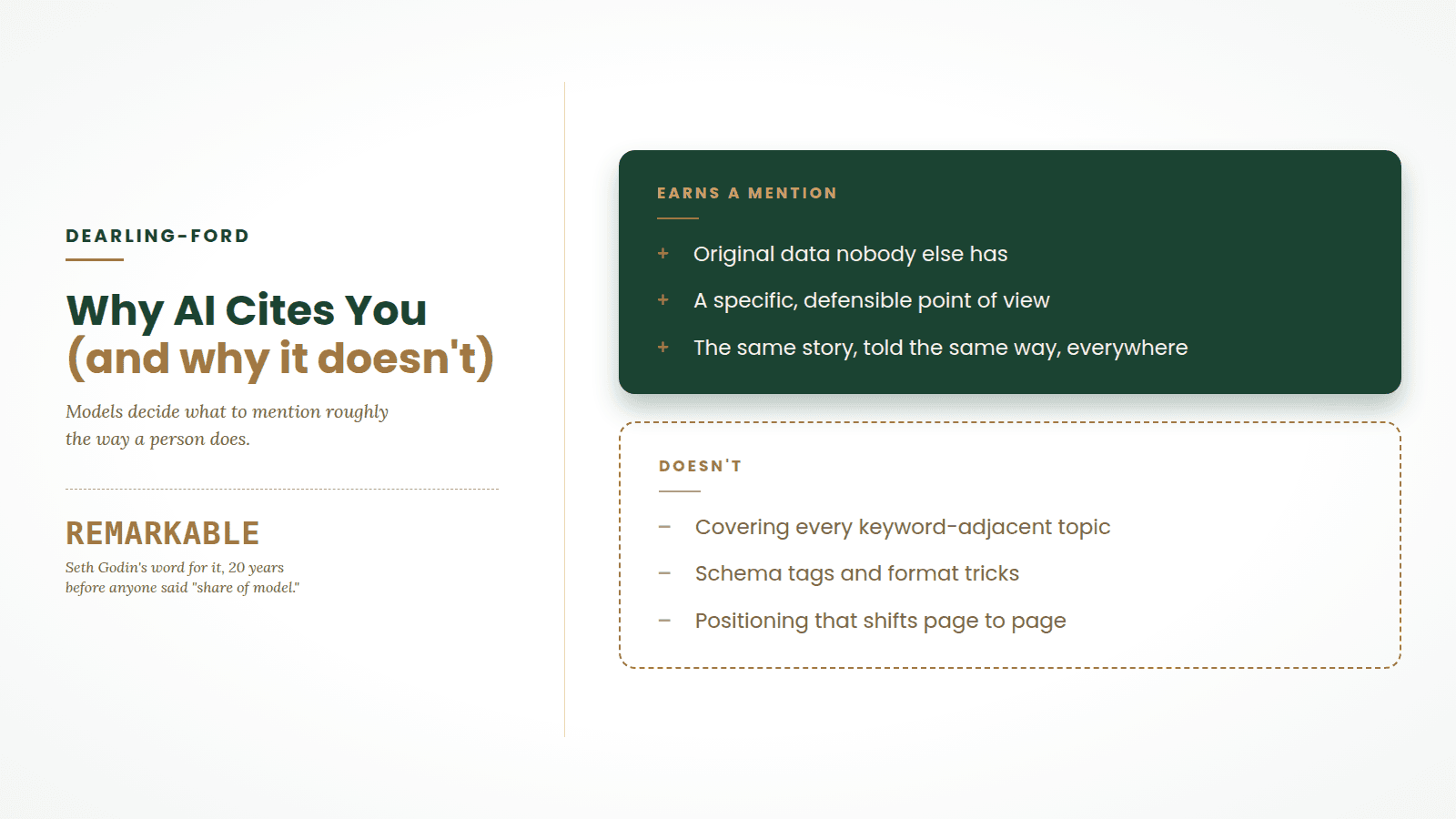
Strip away the acronyms and here's what's happening: AI models decide what to mention roughly the way a person decides what to recommend. Something got noticed. Somebody, or increasingly some model reading what other people have written, decided your brand was worth bringing up unprompted.
That's not a new idea. Seth Godin was making roughly this argument twenty years ago in The Purple Cow, under the word "remarkable": literally, worth making a remark about. Brands that get talked about aren't the ones shouting loudest. They're the ones that did something distinct enough, served someone well enough, or said something clearly enough that another person chose, of their own accord, to bring them up.
At Unity, we sat on data nobody else had: how studios were actually building and shipping games. Rather than producing another routine industry roundup, we published the raw trends in the Unity Gaming Report. The press and the gaming community quoted it widely because the evidence was impossible to find elsewhere. We didn't engineer it to win at search or force remarkability; we simply published clear, original data that solved a genuine information gap. That’s still the definitive standard: not whether content spreads fast, but whether someone references it unprompted.
That same principle governs AI search. "Share of model," the metric several tools now sell you, is really an attempt to count how often your brand gets brought up unprompted across a few thousand simulated conversations. Nobody's agreed on exactly how to measure it yet, and I'd treat any single tool's number with some caution, but that doesn't make it unmeasurable altogether.
Branded search volume, direct traffic, and assisted conversions are older and less exciting, and they tend to move when genuine mentions are rising, usually before any AI-visibility dashboard confirms it. The underlying thing all of this is trying to capture, unprompted mentions earned rather than bought, is the oldest metric in marketing wearing new clothes.
The cost of inconsistency
Here is where brand consistency earns its keep – and not for the reasons traditional style guides suggest.
A model can only cite you with confidence if it can determine, across disparate sources, who you are, what you build, and who you build it for. If your positioning drifts between your website, case studies, LinkedIn, and review platforms, you create ambiguity. That inconsistency does not just confuse prospective buyers; it dilutes the consensus signals an engine needs to verify before it vouches for your brand.
Consistency does not get you cited on its own. It removes the doubt that prevents you from being cited in the first place.
None of this requires reverse-engineering a neural network. It is the same foundational brief content strategy has always had: earn the mention, and make it easy for anyone – or anything – to understand why.
The one durable checklist
If you remember nothing else from this, remember the six things that were true before anyone said "AEO," and will still be true after the term itself is retired.
Solve a real question, better than whoever's currently answering it. Not adjacent to it. Not a slightly different angle on it. The actual question, answered properly.
Write it so it can be lifted cleanly. Not "for AI." For anyone in a hurry. Clear structure, a straight answer near the top, no padding to hit a word count nobody asked for.
Earn mentions instead of manufacturing them. A genuine review, a real quote, a customer who brings you up unprompted, does more than any technical workaround ever will.
Say the same thing, the same way, everywhere. Website, LinkedIn, case studies, sales deck. Consistency isn't a design preference. It's what lets anyone, or anything, vouch for you with confidence.
Publish something only you could have written. Actual experience, a real point of view, a specific example. This is the one part of the process AI genuinely cannot do for you.
Update it when the answer changes, not on a schedule. Nobody has a credible, evidenced case for a magic freshness cadence. Update because you learned something new, not because a calendar reminder fired.
Everything else, the file formats, the schema types, the dashboards, will keep changing. These six won't. Build from here, and the acronym stops mattering.
Frequently asked questions
How long before AEO strategy shows results?
There's no reliable, independently verified number, and it's worth being wary of anyone who gives you a precise one. What's better supported: content built on genuine expertise and consistent brand signals compounds over time in the same way good SEO always did, while tactic-chasing produces short bursts of visibility that tend to evaporate the moment the underlying platform changes its mind, as llms.txt and FAQ schema both show.
Does publishing more content help me get cited by AI tools?
Depends what "more" means. Padding out individual pieces doesn't help: content padding and keyword stuffing were both tested in the original 2024 academic study on this topic, and both did almost nothing. Publishing more pieces that each answer a genuinely different real question is a different story, and can expand your reach, the same logic behind any topic cluster strategy, just faster. The catch is that every one of those pieces still has to clear the same bar as your best work. The moment it doesn't, you're trading reach for the trust that gets anything cited in the first place.
Do I need an llms.txt file?
Almost certainly not, for now. Ahrefs found 97 per cent of the 137,000 llms.txt files it checked had never been requested by anything, and Google has said directly it isn't using the file and has no plans to. If a platform that sends you clients ever asks you for one, create it then. Until that happens, it's effort better spent elsewhere.
Is AEO different from SEO?
Not as much as the marketing around it suggests. Google's own May 2026 guidance for AI features in Search says there are no additional requirements beyond standard SEO fundamentals, being crawlable, clearly structured, and genuinely authoritative. That's not just Google's word for it either, the independent llms.txt and schema tests earlier in this guide found the same thing. Treat AEO as SEO under a faster news cycle, not a separate discipline with its own rulebook.
Need a clearer story? Let’s talk.
Get started